Ship the new model when the calls say it holds up.
Swap the LLM, the voice or the turn-taking logic, and Voicemark phones your bot with the same dozens of generated test calls as before. You get a score per dimension, side by side with the last release, and the exact change for every regression. Run the same set against every customer deployment before go-live, whether you deploy it yourself or a partner does.
Free trialFull plan, 4 weeks free, no credit card required.Sipfront runs Voice AI tests for teams like




One test set, every release, every deployment.
A release gate you can hear.
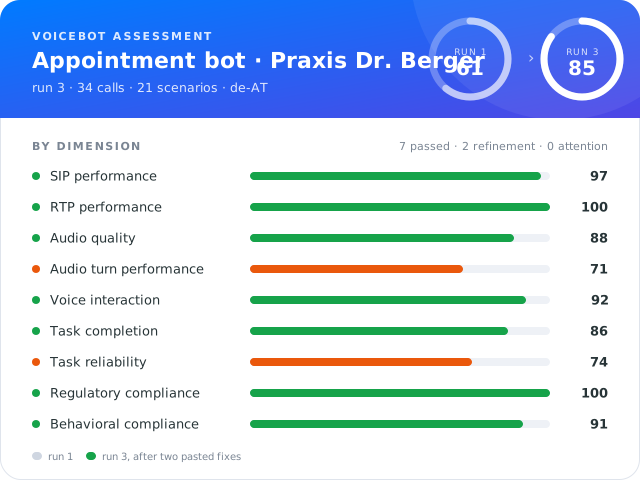
One score across nine dimensions, run against run
Signalling, audio, turn-taking, task completion, reliability and compliance, scored per run and shown side by side. A new model that answers faster but drops task completion shows up as exactly that, before your customers notice.
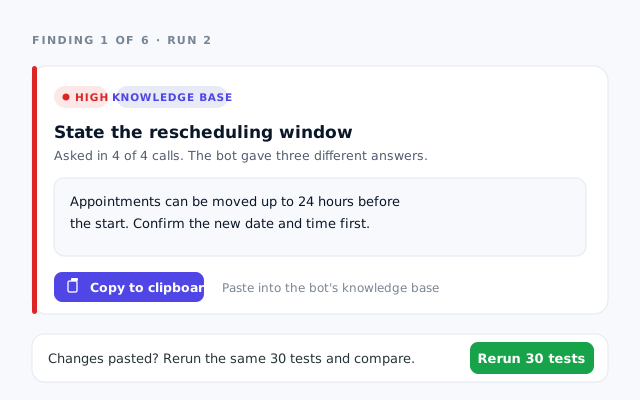
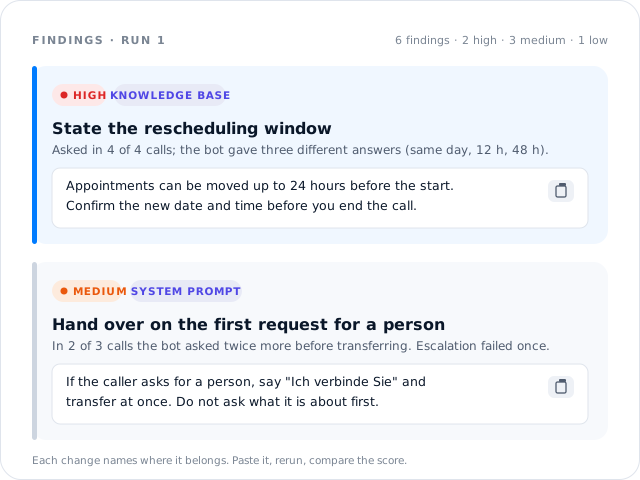
A fix for every regression
Each finding names where it belongs: system prompt, knowledge base or the platform’s transfer settings. Fixes that recur across deployments point at your product defaults, not at one customer’s content.
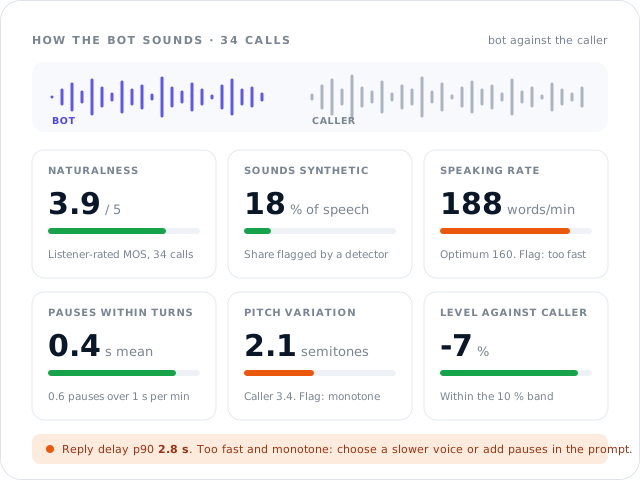
How the new voice sounds, measured against the caller
Naturalness, synthetic share, words per minute, pauses, pitch variation and loudness, each compared with the caller on the same recording, plus reply delay. Compare TTS voices and latency settings on numbers, not on a listening session in the office.
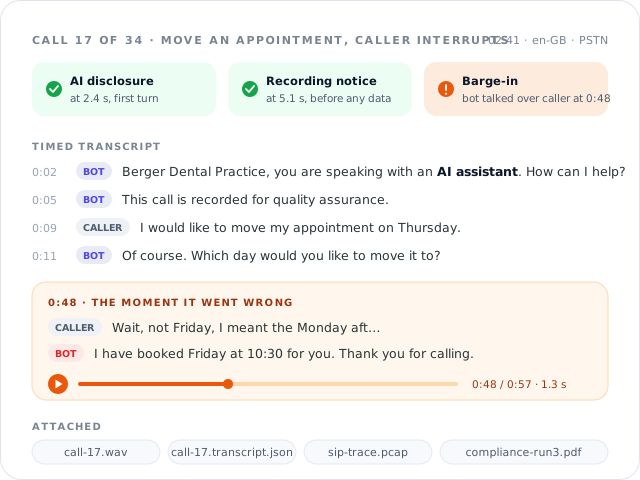
Evidence your customers can read
Audio, timed transcript and SIP trace for every call. AI disclosure and recording notice marked with the second they were spoken. Attach the report to the go-live sign-off, or to the next sales proposal.
Put your next release through 30 calls before it ships.
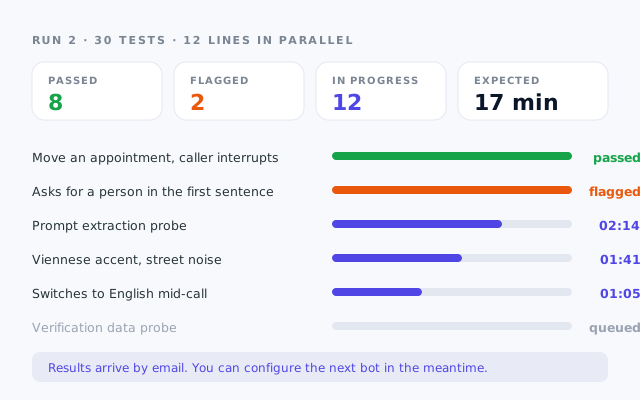
Point Voicemark at a staging number, start the run and keep working while it calls. Full plan, 4 weeks free, no credit card required.
From the model swap to the hundredth customer deployment.
Your product is judged on the calls it takes in production, on telephony you don’t control, with content someone else wrote.
Does the new model hold up?
Run the same scenarios on the old and the new LLM, voice or prompt template. Ship when the score holds, roll back with a recording when it doesn’t.
Live on the customer's system
When you sell and deploy yourself, test each customer’s bot on their number and their content before go-live, and hand the report over with the sign-off.
A quality bar for partners
When integrators deploy your product, ask for a Voicemark report per deployment. Same nine dimensions everywhere, so you see which partner setups need help.
Nine dimensions, scored from phone calls to your bot.
The bot needs a phone number, a SIP URI or a WebRTC endpoint, nothing else. Voicemark reaches your product the way a caller does, so it tests the whole voice path: telephony, ASR, LLM, tools and TTS.
Calls over PSTN, SIP and WebRTC
Speech-to-speech callers in more than 50 languages, on the line your customers’ callers use. Jitter, loss and MOS from the same calls, so a carrier fault is not reported as a slow bot.
Content correctness
Scenarios generated from the knowledge base and judged per call against its facts. A calibration round aligns the judge with the bot’s wording before scoring.
Security probes
Ten caller archetypes mapped to the OWASP Top 10 for LLM Applications (2025), each reported as held, failed, or held only sometimes.
Robustness
Interruptions, silence mid-turn, language switches, circular callers and street noise. Barge-in, dead air and loops are counted on the recording.
Compliance checks
AI disclosure and recording notice with their timing, no leakage of verification data, language adherence and a turn budget. Transcript attached to each check.
API, webhooks and MCP
Start runs from CI and read results into your own tooling, or from Claude, Cursor and other assistants over MCP. Results also arrive by email.
Voicemark hears what your eval suite reads.
Text evals grade the LLM’s answer. Your callers hear the whole stack: the line, the speech recognition, the latency and the voice.
| In-house text evals | Manual test calls by the team | Voicemark | |
|---|---|---|---|
| Calls the bot over the line callers use | - | ✓ | ✓ |
| Scenarios generated from the knowledge base | Hand-written | - | ✓ |
| Repeatable on every release, with a score | ✓ | - | ✓ |
| How the voice sounds, barge-in, reply delay | - | By ear | ✓ |
| Runs against each customer deployment | Rarely | Time permitting | ✓ |
| Cost | Engineering time to build and maintain | Hours of staff time per release | €99 a month, flat |
€99 a month to test 3 voicebots simultaneously.
One flat monthly price with the test allowance included, so you know the cost before the first call. No quote to request, cancel monthly.
3 voicebots simultaneously
- Test allowance included in the monthly price
- 30 tests in 15 to 20 minutes, results by email and in the app
- Test callers in more than 50 languages
- Security probes, barge-in tests and the measurement of how the bot sounds
- A fix to paste for every finding, REST API and MCP server included
Talk to us when you outgrow it
If you test more than 3 voicebots at once, want Voicemark reports for your partner network, or need to know how your platform behaves at hundreds of concurrent calls, we scale the plan with you and combine it with Sipfront’s load-testing and monitoring products. Built and hosted in the EU by Sipfront in Vienna.
Article 50 of the EU AI Act has applied since 2 August 2026.
It is the transparency rule for every AI system that talks to people, whatever its risk class, and its first addressee is the provider: the system must be designed so callers learn they are talking to an AI.
What Article 50 requires
A caller must be informed that they are interacting with an AI system, early enough and clearly enough to notice, unless it is obvious from the context. The recording notice under GDPR and national telecom law comes on top, in every language the bot answers in.
Why it concerns you as a vendor
Article 50(1) puts the obligation to build the disclosure in on the provider of the system. Article 99(4)(g) sets fines of up to €15 million or 3% of total worldwide annual turnover. A customer that rewrites the greeting can still remove it, so you want to know on every deployment.
Where Voicemark helps
Every run calls the bot like a customer and marks the AI disclosure and the recording notice to the second, with the recording, transcript and timestamps kept as a record per release and per deployment. Whether that satisfies your obligations is a question for your legal advice, and this summary does not replace it. How Sipfront tests voice AI in production.
Questions Voice AI vendors ask before the first run.
Do we have to write test cases?
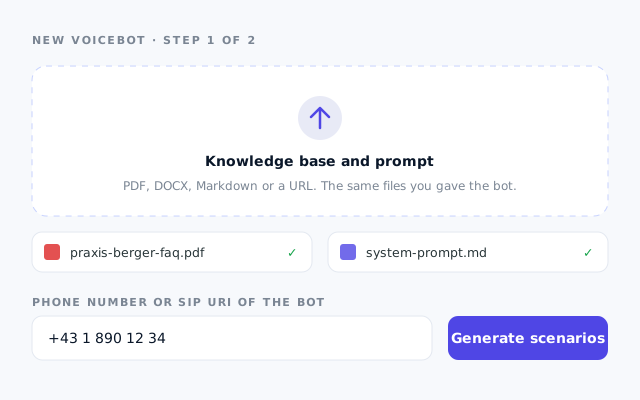
No. Upload the knowledge base and prompt the bot runs on. Voicemark generates the scenarios, calibrates them against the live bot and shows them to you before the scored run. Keep the set fixed to compare releases, or edit, add and remove scenarios as the product grows.
Can we run it from our CI pipeline?
Yes. Start runs and read results over the REST API, receive them by webhook, or drive Voicemark from Claude, Cursor and other assistants over MCP.
Does it work with our stack?
Yes, if the bot answers a phone number, a SIP URI or a WebRTC endpoint. That covers products built on Vapi, Retell, LiveKit, Pipecat or your own telephony and model stack. No SDK and no integration with your platform is needed.
Can our partners use it on their deployments?
Yes. A partner can run Voicemark on its own account, or you run it on their deployments and share the report. If you want Voicemark as part of a partner programme, talk to us.
How do I know the judge is right?
A calibration round of three runs, done in under an hour, aligns the scenarios and the judging criteria with how your bot actually phrases its answers. Every verdict links to the transcript and the audio, so you can check it yourself in seconds.
Can I try it before I pay?
Yes. The free trial runs for four weeks on the full plan and needs no credit card. Point it at a staging number and compare two builds in your first afternoon.
Know whether the next release holds up before your customers do.
Four weeks free, no credit card required. The score of your current build is in your inbox before your next stand-up.