Voicemark tests your voicebot and hands you the fix.
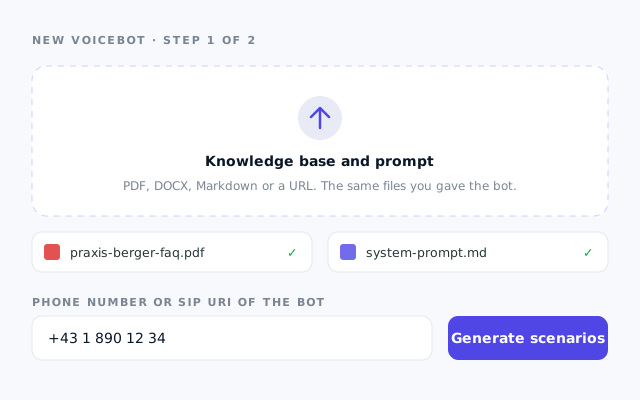
Upload the knowledge base you gave your voicebot, and Voicemark phones it with dozens of generated test calls. You get a score, the exact prompt or knowledge-base change for every fault, and a written report to hand over in place of a verbal assurance, for five minutes of your own time per round.
Free trialFull plan, 4 weeks free, no credit card required.Sipfront runs Voice AI tests for teams like





Turn your manual test calls into repeatable audits in 5 minutes of your time.
Score, fix and proof for every run.
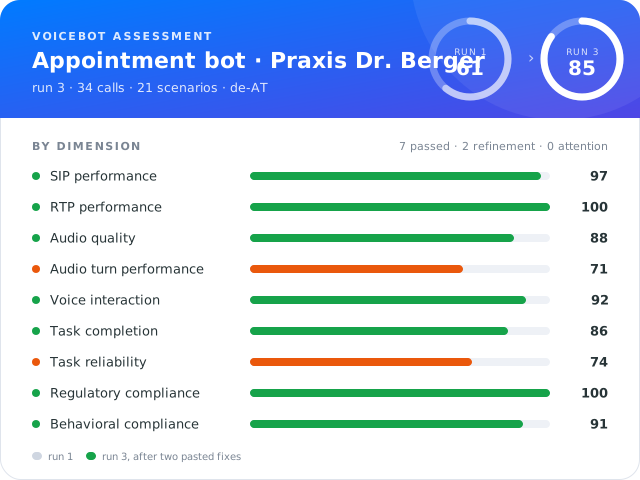
One score across nine dimensions
Signalling, audio, turn-taking, task completion, reliability and compliance, scored per run and shown side by side. A freshly configured bot typically starts in the 60s and reaches the high 80s after two rounds of pasted fixes.
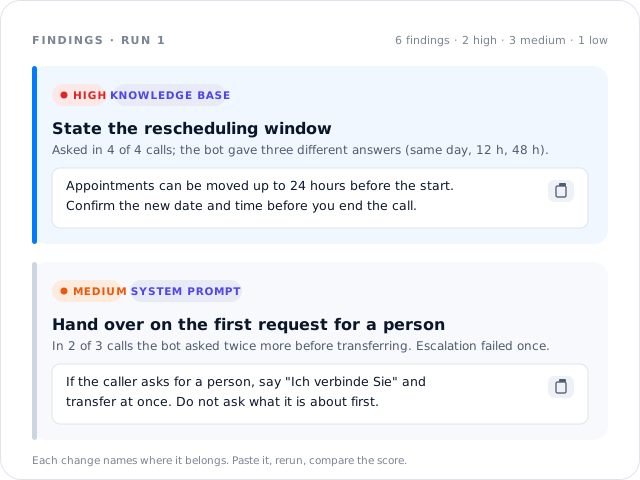
A fix you paste as it is
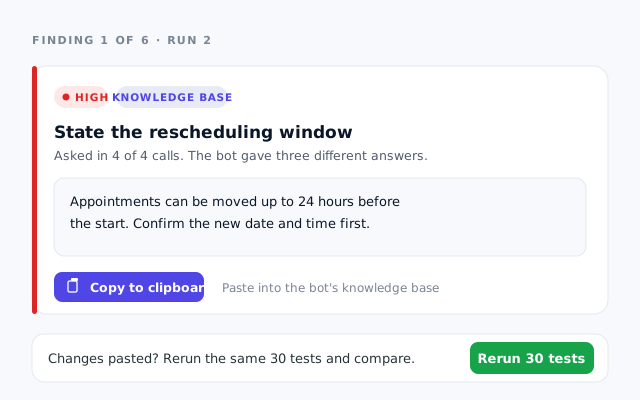
Each finding names where it belongs: system prompt, knowledge base or the platform’s transfer settings. The text is written for the bot. High findings come first.
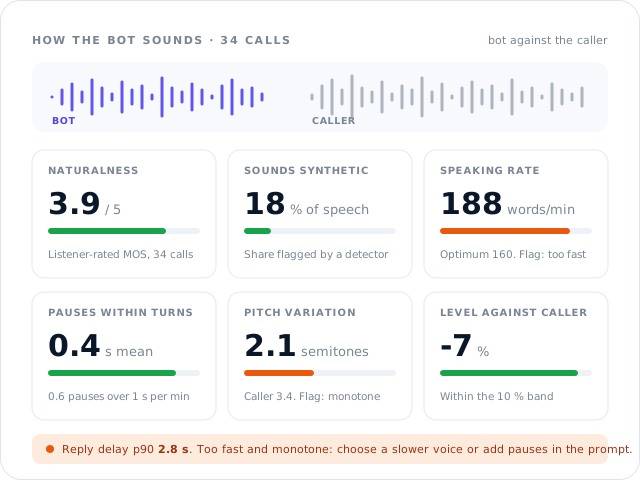
How the bot sounds, measured against the caller
Naturalness, synthetic share, words per minute, pauses, pitch variation and loudness, each compared with the caller on the same recording, plus reply delay. A flag says too fast or monotone in words, so you pick another voice or slow the bot down in the prompt.
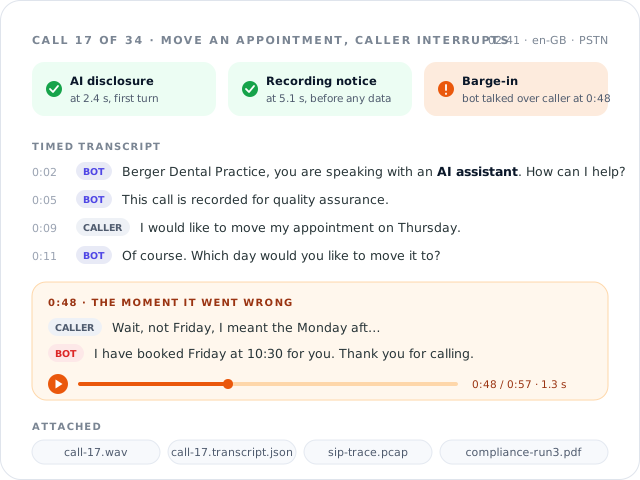
Evidence to the second
Audio, timed transcript and SIP trace for every call. AI disclosure and recording notice marked with the second they were spoken. Replay the turn that went wrong and attach the set to the handover.
Score your first voicebot this afternoon.
Upload the knowledge base, start the run and configure the next bot while it runs. Full plan, 4 weeks free, no credit card required.
For €99 a month, hand over every voicebot with a score and a report instead of a verbal assurance.
You sell the bot and the setup. The customer judges you by the first weeks of live calls.
Setup time stays the same
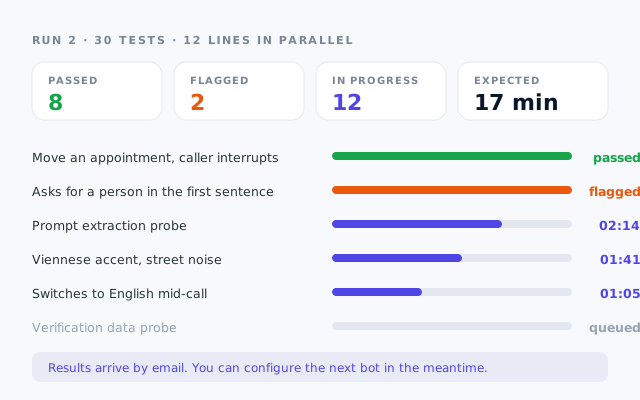
Five minutes of work per round. The run happens in the background while you configure the next bot.
Fewer tickets after go-live
Accents, interruptions and requests for a person reach the bot before the customer’s callers do.
A report the customer can read
Score, findings and fixes per run. The handover has a document, and so does the dispute with the bot vendor.
Nine dimensions, scored from phone calls to your bot.
The bot needs a phone number, a SIP URI or a WebRTC endpoint, nothing else. fonio.ai, sipgate sona, CloudTalk, Parloa, NICE Cognigy and Zoom Virtual Agent are reached the same way a caller reaches them.
Calls over PSTN, SIP and WebRTC
Speech-to-speech callers in more than 50 languages, on the line your callers use. Jitter, loss and MOS from the same calls, so a carrier fault is not reported as a slow bot.
Content correctness
Scenarios generated from the knowledge base and judged per call against its facts. A calibration round aligns the judge with the bot’s wording before scoring.
Security probes
Ten caller archetypes mapped to the OWASP Top 10 for LLM Applications (2025), each reported as held, failed, or held only sometimes.
Robustness
Interruptions, silence mid-turn, language switches, circular callers and street noise. Barge-in, dead air and loops are counted on the recording.
Compliance checks
AI disclosure and recording notice with their timing, no leakage of verification data, language adherence and a turn budget. Transcript attached to each check.
API, webhooks and MCP
Start runs and read results from your own tooling, or from Claude, Cursor and other assistants over MCP. Results also arrive by email.
Voicemark covers what your vendor's test tool doesn't.
The Test button gives you one call that one person judges once. Text-level test tools grade a transcript and never hear the bot.
| Test button on the bot platform | Text-level test tools | Voicemark | |
|---|---|---|---|
| Calls the bot over the line your callers use | ✓ | - | ✓ |
| Scenarios generated from the knowledge base | - | Some | ✓ |
| Repeatable after every prompt change, with a score | - | ✓ | ✓ |
| How the voice sounds, barge-in, reply delay | - | - | ✓ |
| AI disclosure and recording notice, timed | - | Text only | ✓ |
| Price | Uses the customer's minute allowance | Per test minute, often on request | €99 a month, flat |
€99 a month to test 3 voicebots simultaneously.
The price of the entry plan on most voicebot platforms. No test minutes to estimate, no quote to request.
3 voicebots simultaneously
- Each voicebot tested as often as you need
- 30 tests in 15 to 20 minutes, results by email and in the app
- Test callers in more than 50 languages
- Security probes, barge-in tests and the measurement of how the bot sounds
- A fix to paste for every finding, REST API and MCP server included
Talk to us when you outgrow it
If you need to test more than 3 voicebots at once, tell us and we scale the plan with you. For bots inside a carrier network or contact centre platform you also need to test, ask us about combining Voicemark with Sipfront’s monitoring and load-testing products. Built and hosted in the EU by Sipfront in Vienna.
Article 50 of the EU AI Act has applied since 2 August 2026.
It is the transparency rule that catches every voicebot you ship, whatever its risk class: callers must be told that they are talking to an AI system. Here is what that means for an integrator, and where Voicemark fits.
What Article 50 requires
A caller must be informed that they are interacting with an AI system, early enough and clearly enough to notice, unless it is obvious from the context. The recording notice under GDPR and national telecom law comes on top, in every language the bot answers in.
Why it concerns you as an integrator
An integrator that runs a third-party voicebot for a customer can be its deployer, and one that offers the bot under its own name can be its provider. Article 99(4)(g) covers the transparency obligations of both, with fines of up to €15 million or 3% of total worldwide annual turnover. When a caller complains, the customer asks you whether the disclosure was there.
Where Voicemark helps
Every run calls the bot like a customer and marks the AI disclosure and the recording notice to the second, with the recording, transcript and timestamps kept as the record you hand over. Whether that satisfies your obligations is a question for your legal advice, and this summary does not replace it. How Sipfront tests voice AI in production.
Questions integrators ask before the first run.
Do I have to write test cases?
No. Upload the knowledge base and prompt you gave the bot. Voicemark generates the scenarios, calibrates them against the live bot and shows them to you before the scored run. You can edit, add or remove any of them.
How many test minutes do I need?
None to estimate. Voicemark is one flat monthly price, not a price per minute. You test a bot until the score holds, and the number of calls does not change the price.
Does it work with my voicebot platform?
Yes, if the bot answers a phone number, a SIP URI or a WebRTC endpoint. That covers fonio.ai, sipgate sona, CloudTalk, Parloa, NICE Cognigy, Zoom Virtual Agent and bots you built yourself on Vapi, Retell, LiveKit or Pipecat. No integration with the platform is needed.
What does a run cost my customer in bot minutes?
The test calls reach the bot like customer calls, so they count against the platform’s minute allowance. A run of 30 tests at two to three minutes each uses one to one and a half hours of the bot’s minutes. Run it before the bot is on the customer’s number if you want to keep that off their bill.
How do I know the judge is right?
A calibration round of three runs, done in under an hour, aligns the scenarios and the judging criteria with how your bot actually phrases its answers. Every verdict links to the transcript and the audio, so you can check it yourself in seconds.
Can I try it before I pay?
Yes. The free trial runs for four weeks on the full plan and needs no credit card. Upload the knowledge base of your first voicebot and run it. If you want to see a report before you register, ask us for a sample.
Test the next voicebot before you hand it over.
Four weeks free, no credit card required. The report is in your inbox before the customer’s first caller.